
Hey Family,
Did you know???...........
February 16
1857-Frederick Douglass, orator and activist, elected President of Freedman Bank and Trust.
1970- Joe Fraizer knocks out Jimmy Ellis to become world heavyweight champion.
February 17
1942-Huey Newton, founder of the Black Panther Party, born.
1982- Thelonious Monk, jazz pianist, dies, 1982
February 18 Gambia Independence Day
February 19
1919- WEB Dubois, activist, organizes the first Pan-African Congress.
February 20
1900- JF Pickering patents his airship invention.
1927- Sydney Poitier, actor, born.
February 21
1804- Lemuel Haynes, first Black minister to serve for a White congregation, becomes the first Black person to receivean honorary degree (an MA) from a White college (Middlebury College).
1965- Malcolm X, activist and Black nationalist, assassinated.
February 22 St. Lucia Independence Day
1967- Adam Clayton Powell, Jr, activist and chairman of the House Committee on Education and Labor, denied his congressional seat.
***List created by Charles L Isbell, Jr.http://www.seditionists.org/black***
Showing posts with label african american. Show all posts
Showing posts with label african american. Show all posts
Tuesday, February 16, 2010


Did you know? _ This Week in Black History
Hey Family,
Did you know???...........
February 16
1857-Frederick Douglass, orator and activist, elected President of Freedman Bank and Trust.
1970- Joe Fraizer knocks out Jimmy Ellis to become world heavyweight champion.
February 17
1942-Huey Newton, founder of the Black Panther Party, born.
1982- Thelonious Monk, jazz pianist, dies, 1982
February 18 Gambia Independence Day
February 19
1919- WEB Dubois, activist, organizes the first Pan-African Congress.
February 20
1900- JF Pickering patents his airship invention.
1927- Sydney Poitier, actor, born.
February 21
1804- Lemuel Haynes, first Black minister to serve for a White congregation, becomes the first Black person to receivean honorary degree (an MA) from a White college (Middlebury College).
1965- Malcolm X, activist and Black nationalist, assassinated.
February 22 St. Lucia Independence Day
1967- Adam Clayton Powell, Jr, activist and chairman of the House Committee on Education and Labor, denied his congressional seat.
***List created by Charles L Isbell, Jr.http://www.seditionists.org/black***
Did you know???...........
February 16
1857-Frederick Douglass, orator and activist, elected President of Freedman Bank and Trust.
1970- Joe Fraizer knocks out Jimmy Ellis to become world heavyweight champion.
February 17
1942-Huey Newton, founder of the Black Panther Party, born.
1982- Thelonious Monk, jazz pianist, dies, 1982
February 18 Gambia Independence Day
February 19
1919- WEB Dubois, activist, organizes the first Pan-African Congress.
February 20
1900- JF Pickering patents his airship invention.
1927- Sydney Poitier, actor, born.
February 21
1804- Lemuel Haynes, first Black minister to serve for a White congregation, becomes the first Black person to receivean honorary degree (an MA) from a White college (Middlebury College).
1965- Malcolm X, activist and Black nationalist, assassinated.
February 22 St. Lucia Independence Day
1967- Adam Clayton Powell, Jr, activist and chairman of the House Committee on Education and Labor, denied his congressional seat.
***List created by Charles L Isbell, Jr.http://www.seditionists.org/black***
Saturday, December 26, 2009
To those who celebrate- Kwanzaa yenu iwe na heri- Happy Kwanzaa- Archive 2008
 The word "Kwanzaa" comes from the phrase, "matunda ya kwanza" which means "first-fruits." .Kwanzaa was founded in America in 1966 by Dr. Maulana Karenga during the height of the Black Freedom Movement. The core of Kwanzaa comes from the ancient first-fruits celebrations in Africa. Most "harvest" celebrations in Africa last seven days.
 Kwanzaa is celebrated in America and some parts of Canada and Europe as recognized communal celebration was designed to pay ancestral recognition, strengthen, and unite African/Black American people in the U.S. with the Diaspora and Africa. There are some special greetings in used during the Kwanzaa celebration. These greetings are spoken in Swahili. Dr. Karenga chose Swahili as to remind African/Black Americans that all of Africa is their ancestral land, not just one part of the country.
The phrase "Habari gani?"(hah-BAR-ee GAH-nee) not only serve as a way of saying hello but as a daily question in which the answer is each of the principles for each of the days of Kwanzaa. For example; "Umoja" for the first day, "Kujichagulia" for the second day.... etc.
Seven Principles, nguzo saba (in-GOO-zoh SAH-bah)
Dec.26th -Umoja (Unity)(oo-MOW-jah) means unity. desired actions maintain/build unity in the family, community, nationally and racially.
Dec. 27th - Kujichagulia (koo-jee-chah-GOO-lee-ah) means self-determination. desired action: self recognition of strengths and weakness, with the determination to improve or maintain ones productivity and contributions to society.
Dec. 28th - Ujima (oo-JEE-mah) (Collective Work and Responsibility) desired action: to build and maintain community relation as a WHOLE and work together to solve your family/community neighbors problems.
Dec. 29th- Ujamaa (oo-JAH-mah)(Cooperative Economics) desired action- helping build and maintain profits and entrepreneurship, and economic self-sufficiency within the community.
Dec.30th -Nia (NEE-ah)(Purpose) desired action: to help build and develop the Pan-African community to restore pride and tradition of African culture.
Dec.31st- Kuumba (koo-OOM-bah) (Creativity) desired action: in homage of our earth Mother. to do as much possible, in up keeping and improving the community to make it as beautiful and environmental sound as it was naturally intended. This can also be expressed through artisan(handmade) crafts and inventions.
Jan. 1st- Imani (ee-MAH-nee)(Faith) To believe in ourselves, our people and have faith in righteousness and peace will come claim victory for the world. This is also The Day of Meditation (Siku ya Taamuli)
The last day of Kwanzaa is the first day of the new year, January 1. This has been documented as a tradition for some African cultures as a time of deep self-assessment of things ones accomplishments, preparation for future goals, and prayers for peace and healing of unamended issues.
The Symbols of Kwanzaa Kwanzaa has seven basic symbols and two supplemental ones. Each symbolizes traditional values and concepts reflective of African culture.
 (The Harvest Crops) Symbol's of the abundant African as reward for productivity and collective labor.
  (The Mat) Symbolic of African tradition and history.
  (The Candle Holder) Symbolic of our roots, and the ever-living light of our
ancestral people.
 (The Corn) Symbolic of the sweetness of future, the fruits of our labor, our children.
  (The Seven Candles) Symbolic of the Nguzo Saba, the Seven Principles, which African people are urged to live by not just for Kwanzaa but in their everyday lives.
  Kikombe cha Umoja (The Unity Cup) Symbolic of the founding principle (Unity) and reminder of daily practice of this principle.
  (The Gifts) Symbolic of the love of parents and commitments made and kept by the children.
  What do the colors mean??
 The colors of the Kwanzaa flag are the black, red and green:
Black for the African people and its descendants
Red for a reminder of the blood shed in sacrifice for freedom.
Green for the homeland and mother earth. These colors are commonly used as the national colors for African people descendants throughout the world.
I wanted to post this for those who celebrate Kwanzaa and for those who have ever wondered, what the heck is Kwanzaa:)
We celebrate kwanzaa in our home and would like to extend peaceful and warm wishes to all this holiday season. I hope to share so pic of our celebration soon:)
Be Well,
Ny
Thursday, July 16, 2009
Indie Archive- Morgan Street Patisserie April 2009

What a super day! Bright sun, super weather and more soap to spotlight!
Etsy Artist and another fellow EAOC (Etsy Artists of Color Team) member Morgan Street was gracious enough to stop by for a few.
Welcome MorganStreet
1. Introduce yourself _ name, location , Shop name and product(s)you create.
My name is Sharon, I live in Bridgeport, CT. Shop name is Morgan Street and I create all things Soap and Bath & Body.
2. Where did you get your shop name?
I'm originally from England and I my childhood home was on Morgan Street. It's where I learned all things crafty. I still have strong ties there because one of my childhood friends bought the house after my mom passed away and my best friend's parents still live on the street. Whenever I go back, it's like a big family reunion!
3. What brought you to crafting soap?
When my niece was young she had terrible eczema and was unable to take regular baths like her siblings. I felt so sorry for her, I told my sister that I was going to make soap that she could use. I purchased a couple of books and read them over and over for about 6 months before I got the courage to make my 1st batch of soap and I haven't stopped since. ps - my niece has beautiful skin today :-)
4. How did you come to find a home on ETSY?
I had heard about Etsy on and off for a couple of years but didn't fully grasp what it was about until one day, quite by chance I happened on the site again. On that very day at that very time, I signed up and started listing products. I had no expectations at that time but figured it couldn't hurt.
5. What is (are) your favorite pieces in your Shop
That's a difficult one. They're all my favorite. If I had to choose just one, it would be the Chocolate Cake Lip Balm!

6.What is the best piece of advice you can give other aspiring soap crafters who are considering selling their craft?
My best advice would be to do what you love and do it well. Never think you know enough as there's always new things/techniques to learn.
7. In your opinion, why do you think that buying and selling handmade products benefits society especially in today's economy?
Speaking from my own personal experiences here. My company didn't give raises this year and some companies even cut salaries. Despite this, I am able to create what I love. If customers are buying my products, I in turn am able to turn around and spend it right back on Etsy which hopefully is enabling that seller to keep their lights on or buy from another seller. It's just good all around for the handmade movement.
8. Where can we find you other than Etsy to learn more about you? Any other shops?
I'm in the process of resurrecting my own website. The address will be morganstreetsoap.com
My blog is: morganstreetsoap.blogspot.com
Twitter: twitter.com/morganstreet
Flickr: flickr.com/morganstreet
Twitter: twitter.com/morganstreet
Flickr: flickr.com/morganstreet
Indie Archive- The Soap Seduction -April 2009

Simple Sunday Soap Special--Try and say that four times fast LOL!!
I wanted to have those fabulous Friday features but with the gorgeous weather we have been having here along the East Coast I don't blame my features for taking it in;-)
I did get a chance to grab Awesome ArtFire Artist LOVELY Lady behind
1. Introduce yourself _ name, location , Shop name and product(s)you create.
Hello world! My name is Patrice Harrison and I am the brains behind the beauty of The Soap Seduction. I craft soaps, candles, and bath and body goodies.
2. Where did you get your shop name?
I really made the name up out of nowhere. I knew I wanted "soap" in the title so there would be no mistake about what it was I sold. I also wanted something that would be memorable and something a little risque, and nothing says that like "seduction." ;-)
3. what brought you to crafting soap?
I came to make soap as a result of my ashy-prone skin being dried out even more by the commercial detergent bars. Even the so-called "moisture" bars did nothing for me. I also wanted a soap in the scents that I like. I'm very partial to food-based fragrances as I know a lot of people are, and I just couldn't find that commercially. Everything was floral or fruity-floral.
4. How did you come to find a home on ARTFIRE? What are the challenges you find selling your goods online?
Believe it or not, I found ArtFire through a forum thread on EAOC (Etsy Artists of Color). The question was "Does anyone sell on ArtFire...?" and I was like "What the heck is ArtFire..." and with one click, I was hooked. It was new and growing, as I am, and what better way to establish my fledgling business than with a fledgling craft venue. It can be considered a risky move, but I'm quite happy there, and I've been relatively successful in the 4 1/2 months I've been selling there.
The challenges of selling online is staying afloat among the ocean of competition. Sometimes I lose focus because I compare my shop to others, but I find that can lead to discouragement and ultimately failure because you feel you don't measure up. I've since learned that I am unique in my own right and that there's room for everyone. I won't appeal to everyone, but I do have a loyal following.
5. What is (are) your favorite pieces in your Shop
My favorite item of the moment is this orange and bergamot soap.
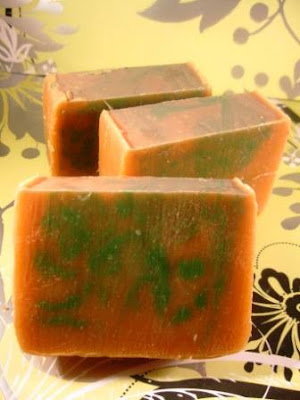 It's both fruity and earthy which makes a seductive (pun intended) combination. It's still curing, but it will be available the week of May 10th.
 It's both fruity and earthy which makes a seductive (pun intended) combination. It's still curing, but it will be available the week of May 10th.
6.Is soap making/ body products your main income, or do you have a "day job" also?
I only wish it were my main income. I do have a day job. I've been in banking for almost 15 years. I enjoy it, and I like knowing where my money is at all times...LOL.
6.What is the best piece of advice you can give other aspiring soap crafters who are considering selling their craft?
The best advice I can give to aspiring soap crafters is be able to defend why you charge what you do for your craft. I can't tell you how many times I've been hit with the "I ain't paying no $5.00 for a bar of soap when I can get 10 bars for the same price at XYZ store...." And to that I tell them, "First and foremost, you're not buying soap, you're buying heavily-scented, overly-drying detergent bars...." Being able to defend your passion is key in any business forum.
7. In your opinion, why do you think that buying and selling handmade products benefits society especially in today's economy?
Let's face it, our economy sucks right now. With so many people out of work, it can be challenging to convince folks to buy your handmade products, but I believe that handmade is the best way to go. It's not only the major corporations who are suffering, but the small business owners are too. Many handmade artisans rely on their craft to support themselves and their families. You may not realize it, but you're buying that bar of soap or those gorgeous pair of earrings are pumping dollars back into our economy. Where do you think we're buying our supplies from? You guessed it: Other small businesses and sometimes, the major corporations. Also, many handmade artisans are using sustainable materials to craft their goods, so not only is handmade healthy for our economy, but our environment as well.
8. Where can we find you other than Artfire to learn more about you? Any other shops?
8. Where can we find you other than Artfire to learn more about you? Any other shops?
I'm trying to take over the web...LOL. I currently sell on Etsy, Funky Finds, and 1000 Markets. I also twitter (http://www.twitter.com/SoapSeduction), and I blog almost daily at www.thesoapseduction.blogspot.com.
Thanks so much for sharing with us Patrice!!! and continued success. Please visit her shops and enjoy the Seduction;-)
Patrice Harrison
www.TheSoapSeduction.artfire.com
www.thesoapseduction.1000markets.com
Subscribe to:
Posts (Atom)


